
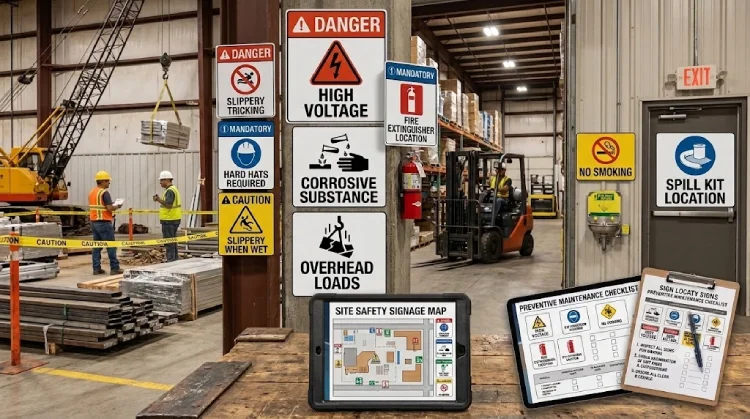
Construction sites, warehouses and industrial facilities are busy environments where workers, vehicles, machinery, hazardous materials and visitors may all operate within the same area. Clear safety signage helps communicate risks, guide movement and remind people about essential precautions.
A well-planned safety sign system can reduce confusion, support workplace safety procedures and help employees and visitors understand what is required in different areas of a facility.
Why Safety Signs Are Important in Industrial Workplaces
Safety signs provide quick visual communication where verbal instructions may not always be practical.
They can help to:
- Warn people about potential hazards
- Identify restricted or dangerous areas
- Show required personal protective equipment
- Guide employees towards emergency exits
- Mark fire safety equipment
- Control vehicle and pedestrian movement
- Provide important operational instructions
Safety signage should be easy to understand, clearly positioned and suitable for the conditions where it will be installed.
1. Warning Signs
Warning signs are used to alert workers and visitors to potential hazards before they enter an area or carry out a task.
Common examples include:
- High voltage
- Slippery surface
- Moving machinery
- Falling objects
- Forklift traffic
- Hot surfaces
- Chemical hazards
- Construction area ahead
These signs are especially important around machinery, electrical rooms, loading zones and active construction areas.
2. Mandatory Safety Signs
Mandatory signs communicate actions that must be followed to enter or work within a particular area.
Typical examples include:
- Safety helmets must be worn
- Safety footwear required
- Eye protection required
- Hearing protection required
- High-visibility clothing required
- Protective gloves required
These signs are commonly installed at site entrances, workshops, warehouses and production areas.
3. Prohibition Signs
Prohibition signs clearly identify activities that are not permitted.
Examples include:
- No smoking
- No entry
- No unauthorized personnel
- No mobile phones
- No open flames
- Do not operate
They are particularly useful in areas where certain actions may create safety risks or interfere with operations.
4. Emergency Exit and Evacuation Signs
Emergency signs help workers and visitors quickly find safe routes during an emergency.
Important examples include:
- Emergency exit
- Fire exit
- Escape route
- Assembly point
- Emergency staircase
- First aid location
Emergency signage should be visible from key work areas and positioned so that people can follow the route without confusion.
5. Fire Safety Signs
Fire safety signs identify the location of equipment that may be required during a fire emergency.
Examples include:
- Fire extinguisher
- Fire hose reel
- Fire alarm
- Fire blanket
- Fire equipment location
These signs should be placed where the equipment can be located quickly and should not be blocked by storage, machinery or other objects.
6. Traffic and Vehicle Movement Signs
Warehouses, logistics yards and construction sites often have trucks, forklifts and other vehicles moving near workers.
Useful traffic signs may include:
- Speed limit signs
- Stop signs
- One-way signs
- Pedestrian crossing signs
- Forklift operating area
- Loading and unloading zone
- No parking
- Vehicle entry and exit signs
Clearly marked traffic routes can help organize movement and reduce conflicts between vehicles and pedestrians.
7. Hazardous Material and Chemical Signs
Facilities handling chemicals, fuels or other hazardous substances should use appropriate signage to identify areas where extra care is required.
Common examples include:
- Flammable materials
- Corrosive substances
- Toxic substances
- Gas cylinder storage
- Chemical storage area
- Hazardous material zone
These signs should be placed at entrances, storage locations and other relevant points where the hazard may be present.
8. Construction Site Information Signs
Construction sites often require additional signage because work conditions can change as the project progresses.
Common construction signs include:
- Construction site – keep out
- Hard hat area
- Authorized personnel only
- Heavy machinery operating
- Excavation area
- Scaffolding warning
- Site office direction
- PPE requirements
Regular reviews are important to make sure site signage still reflects current hazards and access routes.
9. Warehouse Safety Signs
Warehouses need signs that support safe movement, storage and material handling.
Useful warehouse signs include:
- Maximum stacking height
- Loading bay
- Forklift zone
- Pedestrian walkway
- Keep aisle clear
- Emergency exit
- Restricted access
- Maximum load capacity
Signage should remain visible even when shelves, pallets and equipment are present.
How to Choose the Right Safety Signs
When selecting safety signs, businesses should consider the environment where the signs will be used.
Important factors include:
Visibility: Text, colours and symbols should be easy to see from the required distance.
Material: Outdoor signs should be suitable for exposure to heat, sunlight, dust and weather conditions.
Placement: Signs should be positioned where people naturally look before entering a hazardous area or carrying out a task.
Durability: Industrial environments may require materials that can withstand moisture, cleaning chemicals, impact or heavy use.
Consistency: Using a consistent design system makes safety information easier to understand across a facility.
Regular Inspection and Maintenance
Installing safety signs is only the first step. Signs should also be inspected regularly.
Replace or repair signs that are:
- Faded
- Damaged
- Difficult to read
- Covered by equipment
- No longer relevant
- Incorrectly positioned
As a workplace changes, safety signage may also need to be updated.
Conclusion
Effective safety signage helps create a more organized and safer working environment by clearly communicating hazards, restrictions, emergency information and required precautions.
Construction companies, warehouses and industrial facilities should select signs based on their specific working conditions, visibility needs and installation environment.
For businesses looking for durable and professionally produced workplace signage, Gulf Plant Trading & Contracting provides signage solutions for a variety of commercial and industrial applications. Learn more about Safety Sign Board Companies In Qatar.
FAQ
What are the most important safety signs for a construction site?
Common signs include PPE requirements, restricted access warnings, machinery alerts, excavation warnings, emergency exits, first aid signs and fire safety signs.
What safety signs are commonly used in warehouses?
Warehouses commonly use forklift warning signs, pedestrian route signs, loading bay signs, maximum load signs, emergency exit signs and restricted-area notices.
Where should safety signs be placed?
Safety signs should be placed where they are clearly visible before a person reaches the hazard, restricted area or required action point.
Do outdoor safety signs need special materials?
Yes. Outdoor signs should be made from durable materials suitable for exposure to sunlight, heat, dust, moisture and other environmental conditions.
How often should safety signs be inspected?
Safety signs should be checked regularly as part of workplace safety inspections and whenever there are changes to equipment, access routes, work processes or site conditions.
Can the same type of safety signs be used for every facility?
Not always. The required signage depends on the specific hazards, layout, activities and operational requirements of each construction site, warehouse or industrial facility.