
Traffic signs play an important role in guiding drivers, managing vehicle movement and improving safety around roads, construction sites, warehouses, industrial facilities and private developments. However, choosing the right traffic sign involves more than selecting the correct symbol or message.
One important decision is whether your project requires reflective or non-reflective traffic signs.
Both types have suitable applications. The right choice depends on where the sign will be installed, lighting conditions, operating hours, viewing distance and the level of visibility required.
What Are Reflective Traffic Signs?
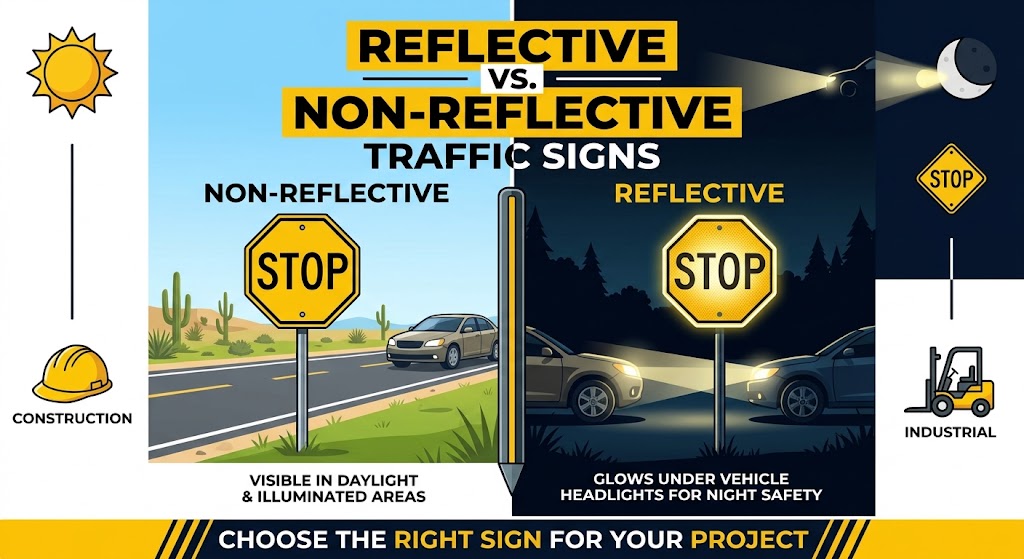
Reflective traffic signs use retroreflective sheeting or similar reflective materials designed to return light toward its source. When vehicle headlights illuminate the sign at night, the sign appears much brighter to the driver.
Retroreflective materials commonly use microscopic beads or prismatic elements to redirect incoming light toward its source, improving nighttime visibility.
This makes reflective signage particularly useful in locations where vehicles operate after dark or in areas where external lighting may be limited.
Common applications include:
- Roads and access routes
- Construction zones
- Parking areas
- Industrial yards
- Logistics facilities
- Warehouses with vehicle movement
- Temporary road diversions
- Site entrances and exits
- Directional and warning signs
What Are Non-Reflective Traffic Signs?
Non-reflective signs use standard printed, painted or vinyl surfaces without retroreflective properties.
They can provide excellent visibility during daylight or in locations with sufficient permanent lighting. However, when headlights shine on them at night, they will generally not provide the same level of visibility as reflective signage.
Non-reflective signs may be suitable for:
- Indoor parking areas with strong lighting
- Warehouses
- Internal factory areas
- Private compounds
- Low-speed environments
- Temporary daytime projects
- Informational signs away from vehicle routes
The suitability of a non-reflective sign therefore depends heavily on its surroundings and how the sign will be used.
Reflective vs Non-Reflective Traffic Signs
Understanding the main differences can make selecting signage for a project easier.
Night-Time Visibility
This is the most significant difference.
Reflective traffic signs become highly visible when illuminated by vehicle headlights, making them particularly useful for roads and areas operating at night.
Non-reflective signs depend more heavily on daylight or artificial lighting.
Daytime Visibility
Both reflective and non-reflective traffic signs can provide good daytime visibility when properly designed.
Clear colours, strong contrast, appropriate sign size and easily recognisable symbols all contribute to readability.
Installation Location
Reflective signs are generally better suited to outdoor vehicle routes, roadways and locations where lighting conditions can change.
Non-reflective signs may work well in controlled environments where lighting remains consistent.
Cost
Non-reflective signs can sometimes have a lower initial cost because specialised reflective sheeting is not required.
However, price alone should not determine the selection. A sign that cannot be clearly identified under the conditions in which it is needed may not fulfil its purpose.
Application
Reflective signs are typically selected when visibility is important during both daytime and nighttime.
Non-reflective options are more suitable when the sign is primarily used during daylight or in consistently illuminated areas.
When Should You Choose Reflective Traffic Signs?
Reflective signage should be considered whenever people need to recognise traffic instructions under low-light or nighttime conditions.
Roads and Vehicle Access Areas
Traffic entering or leaving construction projects, industrial facilities and commercial developments needs clear directional information.
Reflective entrance, exit, speed limit and warning signs can remain easier to identify when vehicles approach after dark.
Construction Sites
Construction sites may operate early in the morning, during evening hours or overnight.
Reflective warning and traffic-management signs can help drivers identify restricted areas, diversions and temporary traffic arrangements.
Warehouses and Logistics Facilities
Large logistics sites often experience regular movement of trucks, forklifts and commercial vehicles.
Reflective signage can be useful along outdoor loading areas, vehicle lanes, gates and parking zones, particularly when operations continue after sunset.
Industrial Facilities
Industrial sites can contain multiple vehicle routes, restricted zones and operational areas.
Clearly visible signs can help communicate directions, warnings and access restrictions to employees, contractors and visitors.
Areas with Limited Lighting
If an outdoor location does not have reliable lighting, reflective signage becomes particularly valuable because vehicle headlights can help make the sign visible.
When Can Non-Reflective Signs Be Used?
Non-reflective signs remain practical for many controlled environments.
For example, an indoor warehouse aisle that is consistently well illuminated may not require the same level of reflective performance as an outdoor roadway.
They may also be appropriate for:
- Internal informational signage
- Daytime-only work areas
- Temporary project information
- Clearly illuminated car parks
- Pedestrian guidance within buildings
- Low-speed private environments
Before selecting non-reflective signs, however, consider whether the location could ever be used during reduced lighting conditions.
Factors to Consider Before Choosing a Traffic Sign
Rather than selecting reflective or non-reflective signage based solely on price, consider the actual conditions of your project.
1. Operating Hours
Will vehicles use the area only during the day, or does the site operate 24 hours?
Projects involving nighttime vehicle movement will generally have greater visibility requirements.
2. Lighting Conditions
Check whether the location has reliable streetlights, floodlights or indoor lighting.
Outdoor lighting conditions can also change because of maintenance issues, construction activity or site development.
3. Viewing Distance
A traffic sign positioned beside a vehicle route needs to remain understandable at an appropriate approach distance.
Sign size, placement, contrast and reflective properties can all influence visibility.
4. Vehicle Speed
Signs along faster-moving vehicle routes normally need to be noticed and understood earlier than signs within slow-moving parking areas.
5. Environmental Conditions
Outdoor traffic signs in Qatar may be exposed to strong sunlight, heat, dust and changing weather conditions.
Appropriate materials, UV-resistant finishes and durable sign substrates can help maintain appearance and readability. Gulf Plant notes that reflective films can improve visibility on roads and open yards, while durable materials and UV-resistant finishes are important for Qatar’s climate.
6. Project Requirements
Road projects, construction zones, government projects, industrial sites and private facilities may have different signage specifications.
Always confirm the required dimensions, symbols, colours, materials and reflective performance before production.
Why Sign Material and Quality Also Matter
Reflectivity alone does not determine whether a traffic sign performs well.
A well-manufactured sign should combine the appropriate reflective or non-reflective surface with a durable substrate, clear graphics and suitable installation.
Common considerations include:
- Weather-resistant sign materials
- UV-resistant graphics
- Strong mounting systems
- Clear and high-contrast printing
- Suitable dimensions
- Easy-to-read symbols and text
- Correct installation height and position
Regular cleaning is also important because accumulated dust can reduce the clarity of outdoor signs.
Which Type Is Better for Your Project?
There is no single option that is suitable for every application.
Choose reflective traffic signs when:
- Vehicles operate after dark
- The sign is installed outdoors
- Lighting is limited or inconsistent
- Drivers must identify signs from a distance
- The project involves roads, construction traffic or industrial vehicle routes
Consider non-reflective traffic signs when:
- The location is consistently well illuminated
- The sign is mainly viewed during daylight
- Vehicle speeds are low
- The sign is primarily informational
- The signage is installed inside a controlled environment
For projects involving important traffic instructions, nighttime operation or changing lighting conditions, reflective signage is generally the more practical option.
Choosing the Right Traffic Sign for Your Project
Selecting between reflective and non-reflective signage should be based on how and where the sign will actually be used. For roads, construction sites, industrial facilities and outdoor vehicle routes, visibility during changing light conditions is especially important.
Working with an experienced signage provider can help you select suitable materials, sizes, finishes and reflective options based on your project’s requirements. Gulf Plant Trading & Contracting provides traffic, safety, directional and other custom signage solutions for projects across Qatar. For customised road, construction and industrial signage requirements, you can learn more from a trusted Traffic Sign Board Supplier In Qatar.
Frequently Asked Questions
1. What is the difference between reflective and non-reflective traffic signs?
Reflective traffic signs use special material that redirects light from sources such as vehicle headlights, making the sign easier to see at night. Non-reflective signs rely mainly on daylight or surrounding artificial lighting.
2. Are reflective traffic signs only necessary at night?
Their main advantage is improved visibility in low-light and nighttime conditions, but reflective traffic signs also remain clearly visible during the day.
3. Where are reflective traffic signs commonly used?
They are commonly used on roads, construction sites, industrial facilities, warehouses, logistics yards, parking areas and other locations where vehicles operate during varying lighting conditions.
4. Can non-reflective traffic signs be used outdoors?
Yes, depending on the project’s requirements and operating conditions. However, locations with nighttime traffic or limited lighting may benefit more from reflective signage.
5. Does dust affect reflective traffic signs?
Heavy dust can reduce the clarity of any sign surface. Regular inspection and cleaning can help maintain visibility, particularly in outdoor and industrial environments.
6. What should I consider when ordering traffic signs?
Consider the installation location, viewing distance, operating hours, lighting, vehicle speed, required sign size, materials and whether reflective visibility is necessary.